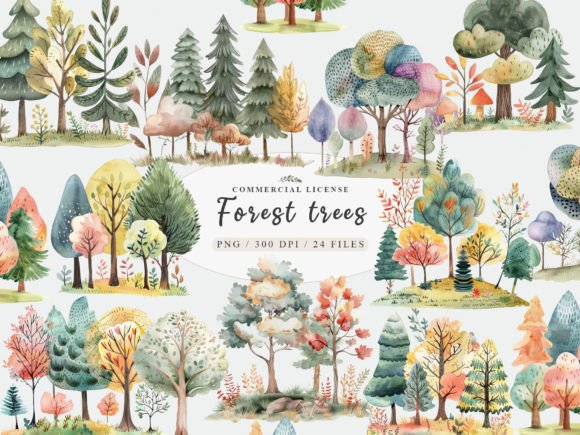
Watercolor Forest Clipart for Creative Projects
If you have spent any time browsing design assets lately, you have likely noticed a shift. More creators are reaching for organic, hand-touched visuals over sterile vector geometry. Among the most versatile options available right now are Magical Forest Clipart and Watercolor Forest illustration sets. These assets bring a tactile, storybook quality to projects that purely digital art often struggles to match. Whether you are designing for a client, building a brand, or working on a personal passion project, these watercolor woodland scenes offer something genuine. They feel less like clipart and more like original paintings you might find in a children's book or an artisan market.
The appeal is immediate. Soft edges, layered washes of green and gold, and characters like foxes, mushrooms, and ferns all rendered in delicate pigment create a world that invites the viewer in. Unlike rigid icon sets, Watercolor Forest illustrations have depth. The paper texture, the bleeding edges, the subtle color blending all contribute to a handmade authenticity that audiences can sense. That emotional resonance is hard to replicate with flat vectors. For designers and small business owners trying to stand out, that humanity matters more than ever.
What Makes Magical Forest Clipart Feel So Distinctive
The personality of these assets leans whimsical but not childish. There is a sophistication in the watercolor technique that appeals to adult audiences. Think of a cottagecore wedding invitation, an organic skincare label, or a nature-themed blog header. The same set of Magical Forest Clipart elements can serve all those contexts because the style is rooted in natural beauty rather than cartoonish simplification.
Color palettes tend to be earthy and muted. Sage greens, warm ochres, dusty pinks, and soft browns dominate. This restraint is a strength. It means the illustrations integrate easily into existing brand identities without clashing. You are not forced to redesign around the asset. Instead, the asset adapts to your existing brand identity. That flexibility is rare in stock design assets, and it makes these clipart sets a smart investment for anyone managing multiple projects.
Another hallmark is the variety of subjects. A strong Watercolor Forest collection usually includes botanicals, woodland creatures, trees, mushrooms, and atmospheric elements like mist or light rays. This range allows you to compose entire scenes rather than dropping a single icon into a layout. You can build a forest floor, frame a quote with branches, or create a repeating pattern for packaging. The creative freedom is substantial.
Where These Illustrations Deliver Real Results
Knowing where to deploy Magical Forest Clipart is just as important as owning it. The assets shine brightest in projects that benefit from warmth and approachability. Here are the contexts where I see them perform best.
Branding and Identity Work
For entrepreneurs launching a lifestyle brand, a tea company, or a nature-inspired product line, these clipart sets provide instant visual language. A logo built around a watercolor tree or a delicate mushroom carries a handmade feel that signals care and quality. Pair the illustration with a clean sans serif font for a modern contrast, or lean into a script font for a romantic, whimsical vibe. The clipart does the heavy lifting for brand personality. You do not need to commission original art. You just need to curate and arrange well.
Editorial and Publishing
Bloggers and publishers can use Watercolor Forest elements to break up text without resorting to generic stock photography. A featured image with a watercolor border, a pull quote framed by leaves, or a chapter header with a small painted acorn all add a cohesive visual thread. The soft quality of the art complements long-form reading. It does not distract. It enhances the reading experience by providing natural pauses and visual interest.
Digital and Social Media Graphics
Social media feeds are crowded. A consistent visual style helps your content get recognized before anyone reads the caption. Using Magical Forest Clipart as a recurring element in Instagram posts, Pinterest pins, or YouTube thumbnails builds that recognition. The watercolor texture reads well on screen and stands out against the polished, high-contrast look many brands default to. It signals a different tone mindful, creative, and human.
Choosing the Right Watercolor Forest Set
Not all clipart collections are created equal. When evaluating a Watercolor Forest set, look for resolution and file quality. Commercial use requires high-resolution files that print cleanly at scale. Check whether the set includes PNG files with transparent backgrounds. That feature alone saves hours of cutting out backgrounds in editing software.
Pay attention to the subject variety. A set with only trees and leaves limits your options. A collection that includes animals, florals, mushrooms, and atmospheric elements gives you a fuller toolkit. I also recommend reviewing the included color palette. A cohesive set will have colors that naturally harmonize. If one element feels jarringly saturated or flat, the whole collection may have quality inconsistencies.
Read the commercial licensing carefully. Many high-quality Magical Forest Clipart sets are sold as commercial fonts or design assets with specific usage limits. Some allow unlimited use in products, while others cap print runs or restrict resale. If you are a small business owner packaging products or a content creator selling digital downloads, confirm that your intended use is covered. Licensing mistakes can be costly.
Pairing Clipart with Type for Maximum Impact
Using Watercolor Forest illustrations well often comes down to typography. The organic nature of the art calls for typefaces that either complement or contrast intentionally. A handwritten font can echo the loose, painterly quality of the clipart, creating a uniform aesthetic. That works well for feminine brands, children's products, or rustic wedding materials.
Alternatively, a clean serif font grounds the whimsy with a touch of seriousness. This pairing is effective for editorial layouts or brand identities that need to balance creativity with credibility. A magazine about herbalism, for instance, benefits from the contrast a sharp serif creates against soft watercolor leaves.
Avoid pairing the clipart with overly technical or sterile sans serif fonts unless you are deliberately playing with tension. Even then, use that combination sparingly. The goal is for the viewer to feel something. Inviting type choices reinforce that emotional connection.
Readability and Visual Hierarchy Considerations
When you layer text over Magical Forest Clipart, readability can suffer if you are not careful. Watercolor textures have low contrast against many type colors. A dark green illustration with black text disappears. Solve this by placing clipart behind lighter text, or by adding a subtle shadow or overlay behind the type. You can also isolate the illustration to margins, headers, and footers instead of using it as a full background.
Visual hierarchy benefits from the varied scale these collections offer. Use a large, detailed watercolor tree as a hero element on a landing page. Then support it with smaller icons or leaf accents at the bottom. That natural scaling guides the eye without needing heavy design tricks. The viewer moves from the big emotional anchor to the smaller details, absorbing information at a comfortable pace.
Building a Cohesive Brand Asset Library
One of the best long-term uses of Watercolor Forest clipart is building a reusable asset library for your brand or business. Instead of searching for new images every project, you create a consistent visual language across everything you produce. That consistency builds trust and recognition with your audience over time. They start to associate that watercolor aesthetic with your specific voice.
Store your assets in organized folders by subject trees, animals, botanicals, textures. Tag them with keywords so you can pull what you need quickly. When you invest in a premium collection, treat it as a long-term tool. The upfront cost of a quality Magical Forest Clipart set pays for itself across dozens of projects.
I have seen small product-based brands transform their entire look by committing to a consistent illustration style. A candle company that uses the same watercolor fern on its labels, website, and social media creates a seamless brand experience. Customers recognize that fern. It becomes shorthand for the brand's values natural, handcrafted, thoughtful. That kind of recognition is hard to buy with advertising. It is earned through visual consistency.
The best advice I can offer is simple. Use Watercolor Forest clipart not as a shortcut, but as a creative partner. Let the natural imperfections of the medium remind you that design does not have to be pixel-perfect to be effective. Some of the most engaging work feels alive. And nothing brings a project to life quite like the quiet charm of a forest painted in watercolor.